


From an outside player, the gig economy has become one of the defining forces in the world of employment, income, and career. By 2024, estimates placed the gross volume of the global gig economy at over 500 billion USD, with forecasts pointing to values well above 2 trillion USD in a decade from now. Over 160 million gig workers are active today across ride-sharing, delivery services, graphic design, web development, consultancy, and beyond.
To those who build and operate such platforms, the upside is clear – but so too is the challenge. Time-to-market pressures, complex multi-sided flows, secure handling of payments and data, and the need for flexibility amid regulatory shifts all apply. This is why Laravel is emerging as an increasingly favored choice of framework for these products – it comes with all of the pieces that these platforms require, neatly packaged within an ecosystem of marketplace, e-commerce, and cloud solutions.
Here’s how the gig economy is shaping up, and why Laravel makes perfect sense for its latest platforms.
The modern gig economy in context
The contemporary gig economy extends far beyond merely food delivery or transportation services. Freelance digital services (software development, design, content creation), tasks (cleaning, repair work, errands), professionals, assets (lodging, vehicles, tools), and a broad array of other niches are included in the gig economy today.
Some figures provide context regarding its magnitude:
- In 2024, the global gig economy was estimated to be worth approximately 556.7 billion USD, with analysts predicting that it will exceed 2.1 trillion USD by 2033.
- Another projection states that the sector will hit 674 billion USD by 2026 and 2.5 trillion USD by 2035, indicating an average growth rate of mid-teens annually.
- Over 160 million people were engaged in the gig and sharing economy globally in 2024, with more than 77 million individuals involved in freelance or task-based gig work.
- Asia-Pacific is the fastest-growing region with over 63 million gig workers, whereas North America is the leader when it comes to earnings per task.
Delving deeper into country-level data:
- Gig economy numbers in India were estimated to be around 7.7 million in 2020-21, rising further to potentially touch 20 million by the end of this decade, despite the fact that these numbers account for only a small part of total employment in the country.
- In the US, it was found that almost 30 percent of people consider gig work as their main job based on extensive surveys, while a third of all adults are engaged in gig activities considering the inclusion of secondary income.
If there is any lesson to learn for those who create platforms, it’s that gig economy is not an experiment anymore; it is fundamental economic infrastructure.
Regional snapshot of gig workers
Here’s a simplified, high-level regional view based on market and policy reports:
| Region | Approximate active gig workers | Notable trend |
| North America | ~42 million gig workers | High per-capita participation and earnings; strong ride-hailing, delivery, and digital freelancing. |
| Europe | ~26 million participants | Balanced mix of freelance digital services and accommodation sharing; active regulation on platform work. |
| Asia–Pacific | ~63 million gig workers | Fastest growth; driven by smartphones and youth unemployment; strong in transportation and task work. |
| Africa & MENA | ~18 million users | Emerging mobile‑first platforms for delivery, transport, and micro‑services. |
You can easily repurpose this table visually in your blog as a “regional snapshot” graphic or overlay.
Where the money flows (pie chart idea)
The contributions from different categories of gigs to overall revenue vary. Transport/Logistics and Delivery take lead in terms of transaction volume, while freelance digital and professional gigs often have higher project values. Platforms for asset sharing such as hospitality and car-sharing generate considerable activity in places where tourism is important.
How to use the pie chart
Use the attached picture of a pie chart for showing:
- An “at-a-glance” indication of how revenue distribution usually looks like for:
- Digital freelancing
- Transport/Logistics + Delivery
- Household/Local services
- Asset sharing
- Various long tail categorie
- Your company’s positioning—where do you fit? High frequency low value or low frequency high value?
Upload the gig_pie.png file as Figure 1: Indicative Revenue Split in the Global Gig Economy to your blog.
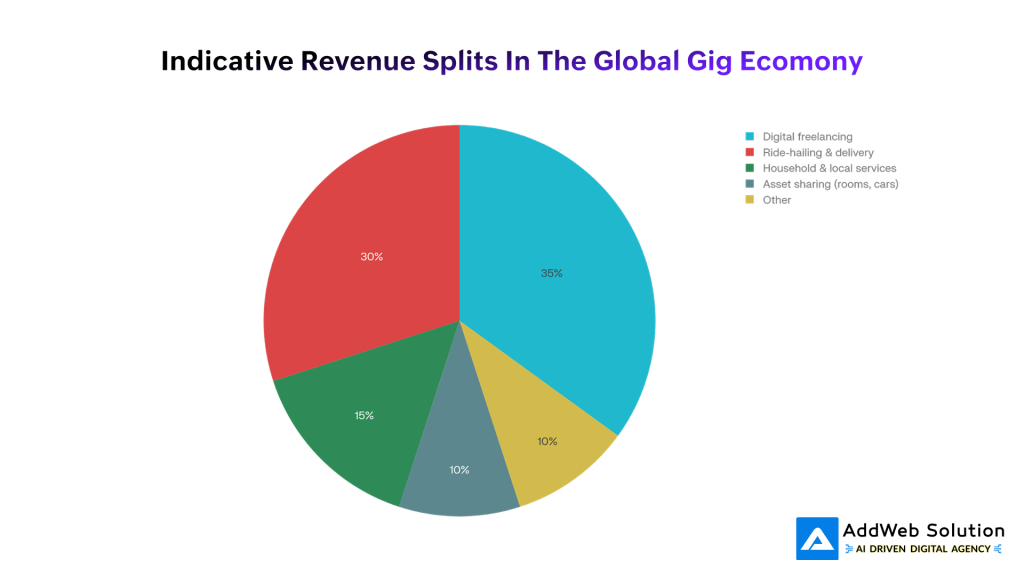
Even without quoting exact percentages, this kind of pie chart instantly tells readers where value tends to cluster in the ecosystem.
Growth over time (bar chart idea)
What matters in the gig economy narrative is not only how big the market already is; it’s also about the growth curve. According to market research data, the industry evolved from several hundred billion dollars at the beginning of the 2020s to projections exceeding 2 trillion dollars by the beginning of the 2030s.
How to interpret the bar chart
Apply the gig_market_bar.png image as:
- A straightforward bar graph labeled “Forecasted global gig economy market value (billions USD)”
- A chronological narrative from the low hundreds of billions to multi-trillions within over a decade
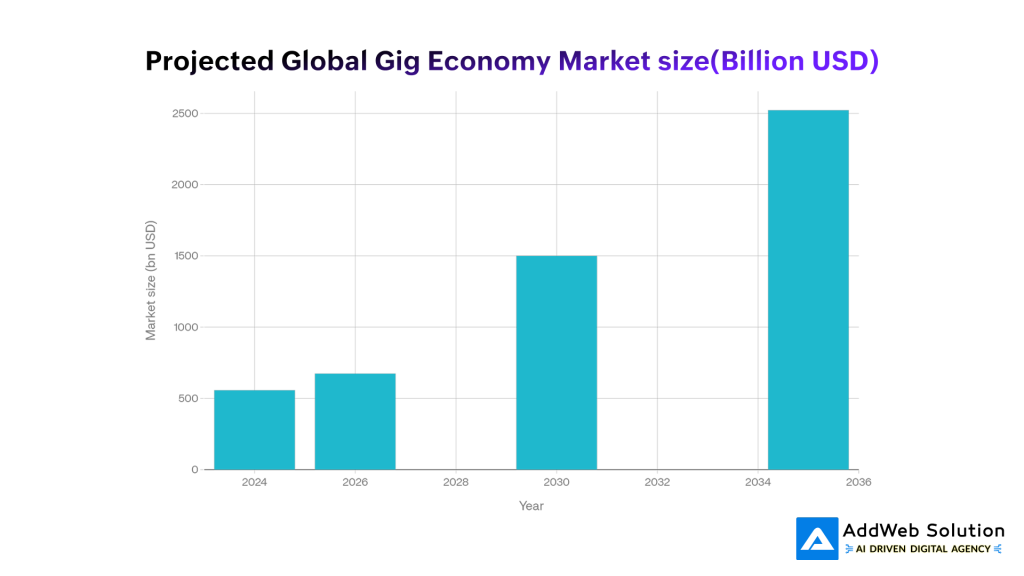
For a Laravel‑based platform, this curve is a reminder that your architecture has to absorb an order‑of‑magnitude increase in users and transactions without a rewrite.
What gig platforms really need in their tech stack
The majority of gig and freelancer platforms (whatever your niche is) will need more or less the same product & engineering capabilities:
- Multi‑sided user flows
Your platform targets at least two types of users (clients and service providers), as well as admins and other stakeholders who all require their own onboarding flows, dashboards, and permissions. - Matching and discovery
You will need robust search and filtering capabilities that enable users to find a designer, driver, or cleaner within seconds. - Trust and safety
To ensure that people will trust each other, your gig platform needs verification, ratings and reviews, and dispute resolution features. - Payments and payouts
It means that you need card payments, wallets, payment splits, fees for the platform, refund management, as well as recurring payouts to service providers or vendors across the globe. - Notifications and communication
In order to facilitate jobs completion, you will need emails, SMSes, push notifications, and even in-app communication. - Scalability and reliability
As soon as you grow up to tens or hundreds of thousands of active users, uptime and performance stop being purely technical problems. - Compliance and localization
You will have to comply with local tax laws, KYC/AML regulations, labor laws, and also support different languages.
Trying to reinvent all of that from scratch is slow and expensive—and often unnecessary.
Why Laravel fits the gig‑platform problem
From a convenient PHP framework for developers, Laravel has evolved into an entire platform for constructing elaborate web applications and APIs. A few of its qualities that make it great for creating gig and freelance platforms include:
- Time-to-market speed
Laravel offers authentication, routing, database migration, testing, and some security functionalities out of the box, saving teams from having to constantly recreate the same basic infrastructure. According to a case study of a gig platform for musicians built using Laravel, a minimum viable product ready for use, offering user sign-up, gig listing, booking, payments, review features, and emails was developed within only three weeks. - Easy development of applications with multiple roles
Laravel has clear and easy routing and middleware functionalities that allow defining specific parts of the application based on the required roles. Multiple-vendor marketplaces built using Laravel have dashboards for vendors and merchants defined this way. - Ecosystem ready for market
E-commerce and marketplace systems like Bagisto that leverage the Laravel framework have features for managing vendor registration, catalogs, orders, and commissions. These features can be reused to offer services or gigs rather than goods. - Modern infrastructure and developer tools
Queues, jobs, caching, and testing are first-class citizens, making it simple to create robust pipelines for matching jobs, invoicing, and notifications without battling against the framework. - Deployment in cloud-native environments
Laravel app hosts deliver autoscaling, secure environment management, and zero-downtime deployments, allowing you to concentrate on the product rather than the infrastructure.
For business stakeholders, this means shorter cycle times on new features, less friction hiring developers, and a realistic path to scaling without throwing away the original codebase.


Real‑world marketplace patterns with Laravel
There are some public case studies and developer descriptions of building full-fledged marketplaces using the Laravel framework. They may not be all gig platforms, but their architecture is practically the same.
- Freelance Musicians Marketplace
The developers have used Laravel to integrate musician and venue sign-up forms, profiles, posting and scheduling gigs, payments (artists’ fees and commissions to the platform), reviewing gigs, and notifications through emails into a unified framework. - Marketplace design inspired by multi-vendor e-commerce
Bagisto is one such Laravel-based framework that offers multi-vendor marketplace functionality with separate dashboards for vendors who manage products and place orders, and receive payments from the central administration system. Just replace “vendors/products” with “freelancers/gigs,” and the pattern fits most service marketplaces. - Multi-vendor Digital Goods Marketplace with Laravel 12
Here, a developer created a digital goods marketplace on Laravel 12 that includes a frontend for selling goods, a backend for administrators, and two additional backends for authors and reviewers, along with payment and payout processing through Stripe, and caching and queuing.
These examples show Laravel running real production marketplaces with complex transactional logic—not just basic CRUD websites.
Product needs vs. Laravel capabilities (table)
Here’s a simple mapping from common gig‑platform needs to capabilities available in the Laravel ecosystem:
| Product need | What the platform must do | How Laravel helps |
| Fast MVP launch | Validate a new marketplace model quickly, without rebuilding core plumbing. | Built‑in auth, routing, migrations, and mature packages shorten time to first release. |
| Multi‑role experiences | Provide separate dashboards and permissions for workers, clients, support, and admins. | Routing and middleware patterns cleanly separate panels and apply role‑based access control. |
| Complex payment flows | Handle platform fees, worker payouts, refunds, and periodic settlements. | Strong integrations with gateways like Stripe plus queues and webhooks for reliable processing. |
| Search and matching | Let users discover the right worker, task, or project quickly. | Query builders and APIs make it straightforward to build search endpoints and integrate search services. |
| Notifications and engagement | Keep both sides informed about new jobs, changes, and payouts. | Queue and mailer systems support email and background jobs; events can drive real‑time updates. |
| Scaling across regions | Support more users, more traffic, and localized experiences across multiple geographies. | Managed Laravel hosting provides autoscaling and secure deployments across environments. |
You can turn this table into a visual “feature matrix” in your blog or presentation.
The human side of gig platforms
Behind every Laravel service container and queue worker is a human trying to pay bills, manage time, and build a life. Many reports highlight that a significant share of gig workers earn relatively low monthly incomes and face volatile earnings, even as the overall sector grows. In one national survey, nearly 40 percent of gig workers were estimated to earn below a modest monthly income threshold.
At the same time, many workers say they choose gig work for flexibility, autonomy, and the ability to stack multiple income streams. Younger workers often use platforms to supplement income while studying, caregiving, or exploring careers.
For teams building Laravel‑based platforms, these realities should inform product decisions:
- Transparent payout dashboards and fee breakdowns can make income feel more predictable.
- Clear dispute processes, ratings, and communication tools help workers feel safer when dealing with clients.
- Optional features like savings pots, early payout options (where regulations allow), or benefits partnerships can materially improve worker wellbeing.
The same framework that powers routing and payments can power better financial education, protections, and support flows if those priorities are baked into the roadmap.
Practical design tips for Laravel gig platforms
Make onboarding frictionless
Gig workers and clients often try multiple apps before committing to one. Laravel’s authentication scaffolding, validation tools, and integration with social logins help streamline sign‑up while still capturing essential KYC data where required.
Design ideas:
- Start with minimal required fields, then collect more details as users engage (“progressive profiling”).
- Split worker and client journeys into clearly separate onboarding flows and dashboards, aligned with different expectations.
- Localize onboarding for each region—language, tax fields, document uploads—rather than forcing a one‑size‑fits‑all flow.
Design for trust from day one
Trust is the currency of any gig platform. Laravel makes it straightforward to combine identity verification, profile completeness indicators, reviews, and dispute workflows into a cohesive experience.
Useful components:
- Verification badges once identity or documentation checks are complete.
- Tiered verification levels that unlock higher‑value gigs or faster payouts.
- Clear timelines and status updates around disputes, refunds, and reviews.
Build around payments and cash flow
For many gig workers, your platform is not a hobby; it is a primary income source. Payment reliability is therefore part of your value proposition, not just a back‑office function. Laravel’s queues, events, and payment integrations allow you to design reliable payouts, reconciliations, and clear fee breakdowns.
Think about:
- Supporting multiple payout options (bank transfer, local wallets, UPI or regional equivalents) depending on geography.
- Making commissions, taxes, and net earnings completely transparent inside worker dashboards.
- Exploring features such as minimum payout thresholds, savings pots, or earned‑wage access where regulations allow.
Prepare for regulation and compliance
Regulation of gig work—classification, benefits, data protection—is evolving quickly. Laravel’s modular structure makes it feasible to isolate compliance‑related features such as consent flows, data export tools, and jurisdiction‑specific terms so they can evolve without destabilizing the rest of the app.
Plan ahead for:
- Clear consent and privacy notices tuned to each country’s legal requirements.
- Region‑specific terms of service and worker agreements.
- Audit logs for critical actions like payouts, disputes, and rating changes to support investigations and audits.
Laravel and the future of freelance work
As the gig economy matures, the platforms that endure will be those that combine healthy economics with genuine care for workers and clients. They will need to localize quickly, integrate with financial services and benefits, and experiment with new models such as cooperatives, revenue‑sharing, or hybrid employment structures.
Laravel will not solve policy questions on its own, but it gives product teams a practical foundation to build and iterate on these ideas faster. With a mature ecosystem, strong developer experience, and modern deployment options, Laravel is well positioned to power the next generation of gig platforms—from local service apps to global freelance marketplaces.
For founders, the real question is no longer whether the gig economy will keep growing—it already is—but whether your platform can evolve as quickly as worker expectations, regulations, and market opportunities. A well‑designed Laravel stack gives you a serious head start.
Not sure which tech stack fits your marketplace idea?

Pooja Upadhyay
Director Of People Operations & Client Relations
⁂
- https://www.ijfmr.com/papers/2025/4/50486.pdf
- https://www.businessresearchinsights.com/market-reports/gig-economy-market-102503
- https://www.moneycontrol.com/news/business/startup/economic-survey-2026-about-40-percent-of-gig-workers-earn-below-rs-15000-a-month-13797246.html
- https://www.niti.gov.in/sites/default/files/2023-06/Policy_Brief_India’s_Booming_Gig_and_Platform_Economy_27062022.pdf
- https://niwr.org/wp-content/uploads/2024/01/Gig-Economy-By-The-Numbers_The-Institute_2023.pdf
- https://www.techtarget.com/whatis/feature/Gig-economy-statistics
- https://indianjournalofeconomicsandresearch.com/index.php/aijer/article/view/174571
- https://cloud.laravel.com
