


Executive Summary
The beauty and skincare industries are witnessing a transformational change in their landscape. Over 40 percent of beauty products sold worldwide happen through digital channels, with this trend increasing each quarter. Shopify has proven to be the go-to platform for all sizes of beauty businesses, from $500K indie skincare brands to billion-dollar prestige brands that operate on an omnichannel scale.
This blog dives into the landscape and tells you what’s really happening. Which trends are driving the beauty eCommerce industry forward? What apps, tools, and integrations do you need in your tech stack to achieve success? Finally, where exactly are beauty brands missing out when they see their Shopify store as nothing more than a catalogue?
This is your ultimate guide to beauty brands and skincare brands on Shopify.
The Beauty & Skincare eCommerce Landscape in 2025
However, it isn’t just another category – one of the most emotionally driven and repeat purchase friendly categories in the retail sector. Once a customer finds their moisturizer or serum, you have them for life. The task is bringing them there. Before we even think about technology, we need to consider the market context.
Market Size & Growth Trajectory
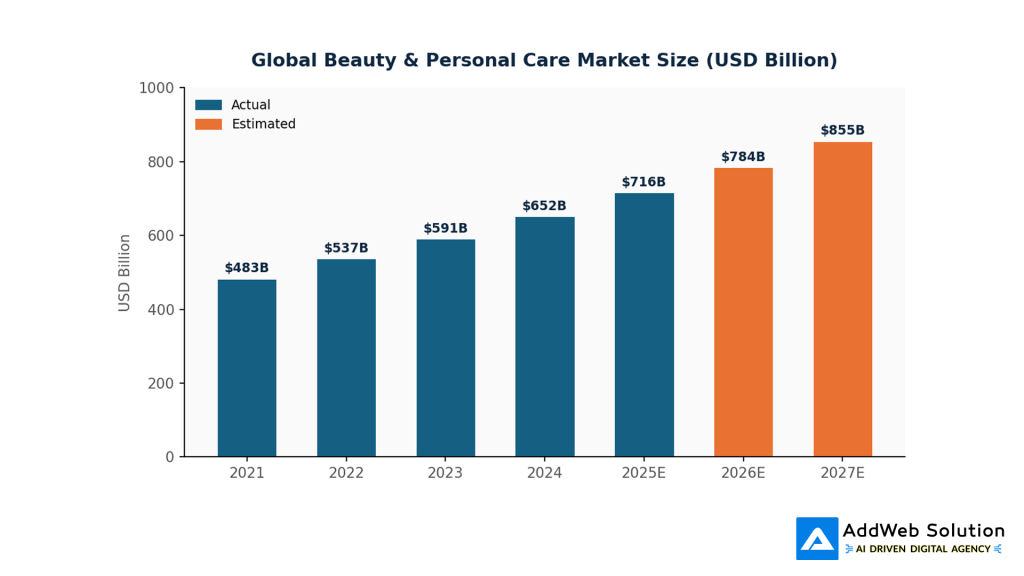
Fig 1.1 – Global Beauty & Personal Care Market Size (USD Billion), 2021-2027E. Sources: Statista, Grand View Research, Euromonitor
It is estimated that the market for beauty and personal care worldwide will exceed $855 billion by 2027, expanding at a rate of about 5.5% CAGR. Skin care makes up about 42% of the total revenue here, hair care accounting for 23%, color cosmetics 17%, and fragrances 9%. E-commerce revenues from sales of beauty products have been expanding at close to double this rate; beauty eCommerce revenues are anticipated to expand by an estimated 10–12% every year through 2027.
Three major megatrends are contributing to these numbers:
- ‘Skintellectual’ consumers: today’s shoppers understand the ingredients better than ever before, conducting extensive research and cross-referencing before making a purchase. This is advantageous to beauty brands which offer informative, detailed descriptions of their products on eCommerce sites, coupled with solid SEO.
- Expansion of the global middle class: disposable income growth in South Asia and Southeast Asia means huge potential new markets for skincare brands.
- The proliferation of skincare: multi-step skin care routines mean bigger baskets; AOV for skincare DTC brands has increased by 30-40% over the last five years.
Platform Adoption: Where Beauty Brands Are Building
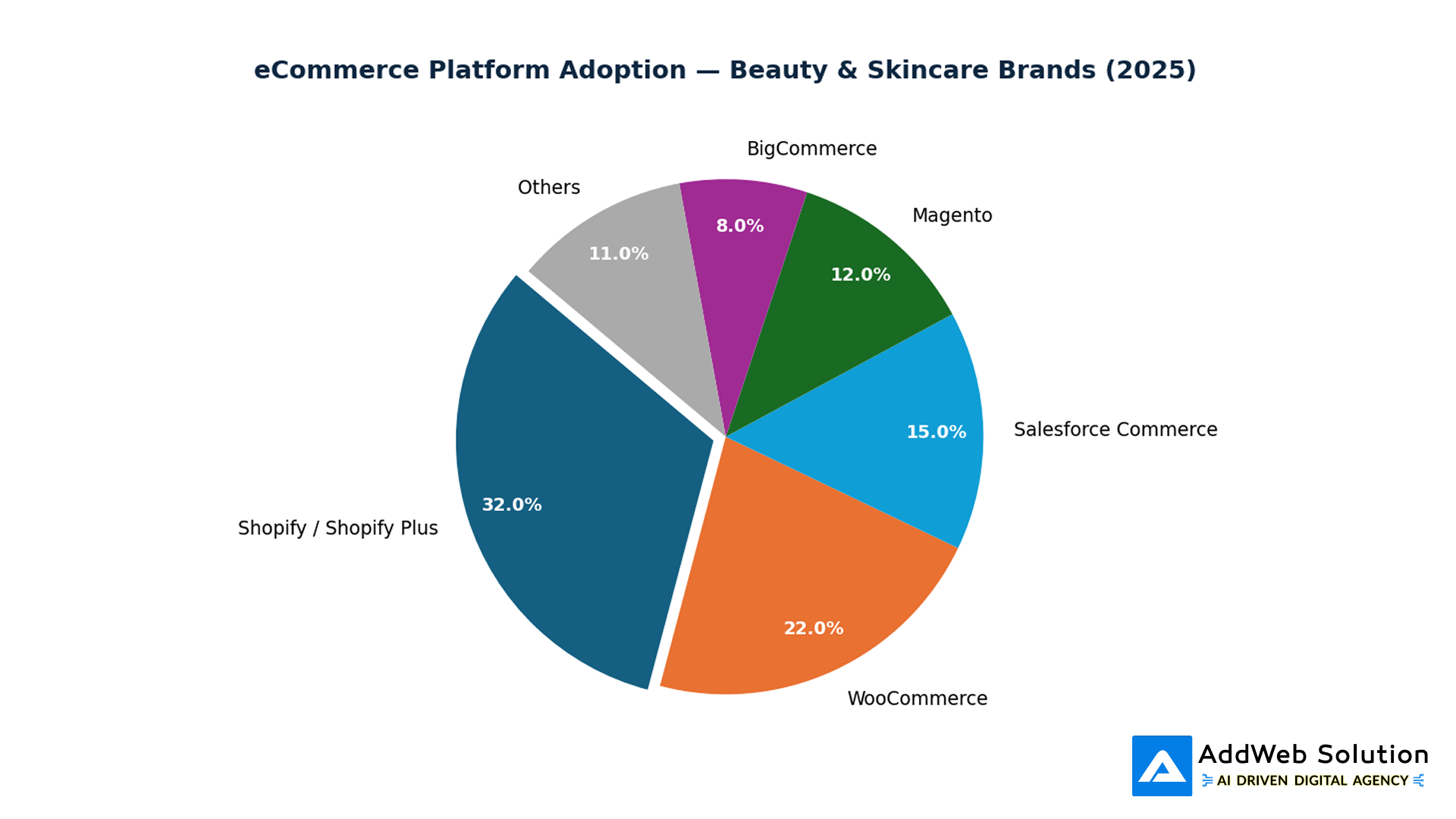
Fig 1.2 – eCommerce Platform Adoption Among Beauty & Skincare Brands, 2025. Sources: BuiltWith, Shopify Partner Research
Shopify along with Shopify Plus holds about 32% share in the eCommerce platform market amongst beauty brands, which is the largest share held by any platform. The next biggest competitor, WooCommerce, takes about 22% of the market; however, many beauty businesses using WooCommerce platforms are moving over to Shopify due to superior checkout, apps, and subscription capabilities.
How Beauty Brands Generate Revenue on Shopify
Revenue Distribution by Sales Channel

Fig 2.1 – Average Revenue Distribution by Sales Channel for Beauty Brands, 2025. Sources: Industry benchmarks, Shopify Partner Data
Direct-to-Consumer continues to be the key channel for most beauty brands built on Shopify, driving around 38% of mixed revenues. Nevertheless, the multichannel approach is not a choice anymore but an essential starting point. For beauty brands, it’s not safe to go with only one channel – the best growth results are achieved by utilizing Shopify as the central platform and distributing the product through various marketplaces, social commerce, and subscription platforms.
The DTC Advantage for Beauty
First of all, DTC is crucial for the brand since with DTC, the brand owns customers’ personal information. With such purchases, a company gets access to their purchasing history, the email list, frequency of recurring purchases, and information about skin issues (in case if quizzes are utilized). All of this information helps to create relevant marketing approaches like personalized email funnels and ingredient educational campaigns.
On average, brands that have well-developed DTC business operations on Shopify and use a proper retention strategy usually achieve:
- Higher LTV (2-3 times) compared to marketplace only
- 25-40% of email revenue attribution compared to total DTC monthly revenue
- Repeat purchase rate for skincare essentials – 45-65%
Social Commerce: The Rising Channel
Social Commerce, which involves buying via Instagram, TikTok, and Pinterest, accounted for around 12% of the revenue of beauty brands in 2024 compared to less than 5% in 2021. Since Shopify has built-in integration with TikTok Shop, Instagram Shopping, and Pinterest Buyable Pins, beauty brands can have control over all their social commerce inventory and fulfillment within one dashboard.
Top Trends Shaping Beauty eCommerce in 2025
1. Hyper-Personalization via Skin Quiz Funnels
In the realm of beauty DTC, skin quizzes have evolved into a mainstay of the strategy, and the Shopify app ecosystem makes its deployment very simple. Examples of this include companies such as Curology, Function of Beauty, and Proven Skincare, whose entire business models are based on personalization. Even companies without personalized products use quizzes to direct buyers to relevant products, increase cart sizes, and obtain first-party data.
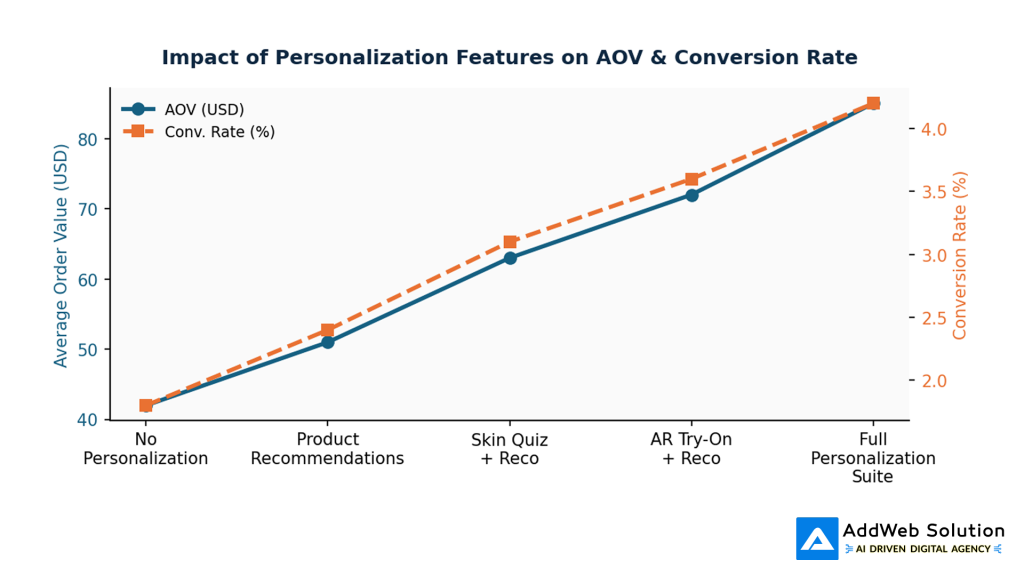
Fig 3.1 – Impact of Personalization Features on AOV & Conversion Rate. Illustrative benchmark based on industry data.
The numbers are impressive – the average basket value can be increased by up to 2 times for businesses that use a full-fledged suite of personalization tools compared to those without any personalization set up at all. Conversion rates increase just as much from less than 2% for early adopters to more than 4%.
2. AR Try-On and Virtual Beauty Experiences
Try-on in augmented reality (AR), where users can try on makeup like lipstick, foundation, or eyeshadow on their smartphone screen, is not just another cool experience anymore. Rather, it is a standard option for any color cosmetic brand. Shopify provides a native solution for 3D rendering of products as well as an AR Quick Look experience on iPhones. Dedicated platforms for beauty AR solutions integrate seamlessly into a Shopify store.
And the benefits speak for themselves: lower returns (less “I ordered the wrong shade”), higher engagement, and conversion boost – all thanks to try-on capabilities. Brands with shade matching AR tools observe a 15-25% reduction in their return rates for foundations.
- Main AR integrations in Shopify stores for beauty products: Perfect Corp YouCam, ModiFace (L’oreal), Revieve, Banuba
- Shopify native support for 3D/AR comes with support of .usdz format (iOS) and .glb (Android)
- Combine AR with skin tone quiz for best results
3. Subscription Commerce and Refill Models
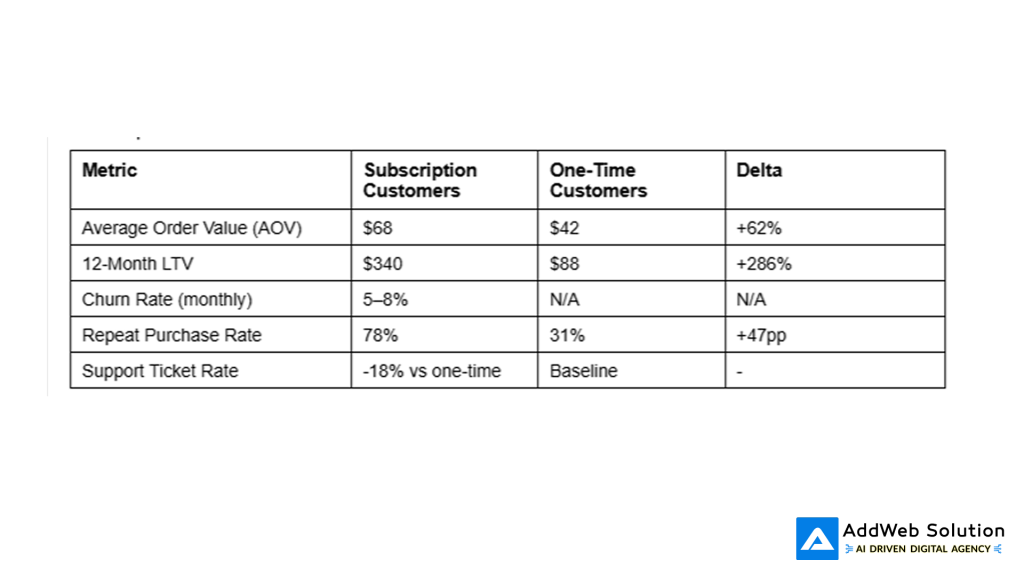
The skincare industry is a natural fit for the subscription model. Moisturizers have a finite shelf life. SPF products need replacing. Serums are applied daily. On average, the skincare consumer who follows a 3-step regimen replenishes her products every 60 to 90 days, making it the near ideal cadence for a subscription service.
Beauty subscription services can be implemented seamlessly using Shopify’s built-in tools or third-party apps such as Shopify Subscriptions, Recharge, or Skio. Important metrics for beauty subscription businesses:
4. Clean Beauty, Transparency, and Ingredient Education
This is no longer a specialty but a mainstream expectation – consumers research ingredient labels, seek third-party certifications (EWG Verified, COSMOS, Leaping Bunny), and validate their own findings on app-based resources such as INCI Decoder and Think Dirty. In today’s consumer landscape, transparency leads to quicker credibility and a sustainable level of trust.
For e-commerce platforms using Shopify, this includes at least four key areas of development and content updates:
- Ingredient databases: individual web pages describing each active ingredient, its purpose, and percentage. SEO heaven!
- Certifications added as metafields: structured data for such categories as Cruelty-Free, Vegan, Fragrance Free, Dermatologist Tested, etc.
- Hover-over/expanded explanations of ingredient list: apps that provide the information directly on the product pages.
- Full formula disclosure: listing all the ingredients in the INCI list form
5. Sustainability and Refillable Packaging
The concept of sustainability not only stands for values but also for innovation in the form of a new business model in the beauty sector. The use of refill packaging, where the consumer buys a discount-priced refill pod and uses the same casing multiple times, ensures repeat purchase and creates loyal customers. Many companies like Kjaer Weis, Dior, and Charlotte Tilbury have successfully launched a refill program.
In Shopify, there are two ways to do a refill program, which can be classified into: (1) paired SKU method, in which the refill SKU is sold at a reduced price point; or (2) subscription, where the refill pod gets delivered to the consumer automatically.
The Abandonment Problem in Beauty eCommerce
Cart abandonment averages 70% within eCommerce, yet in the beauty industry, the problem is more complex. Beauty shoppers may use the add-to-cart process as a save-for-later strategy, and their reason for abandonment can typically be solved with the proper checkout and UX stack.
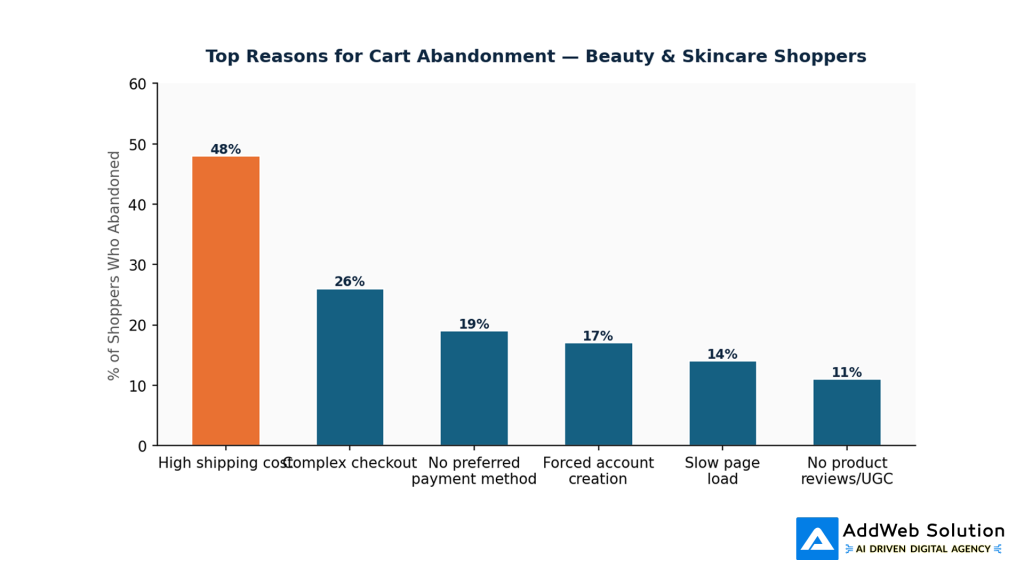
Fig 4.1 – Top Cart Abandonment Reasons, Beauty & Skincare Shoppers, 2025. Sources: Baymard Institute, proprietary survey data
High shipping fees continue to be the most significant factor driving abandonment. Free shipping cut-offs, which generally range between 20–30% of AOV, are the best tool for not just cutting down abandonment rates but also boosting average order value. It’s pretty simple, really – someone who has $65 worth of products in their cart is going to pick up a travel-size item costing $15 just to qualify for free shipping at $75.
The second and third drivers (complex checkout and no preferred payment method) are entirely addressable with Shopify’s extensibility stack.
The Ideal Shopify Tech Stack for Beauty & Skincare Brands
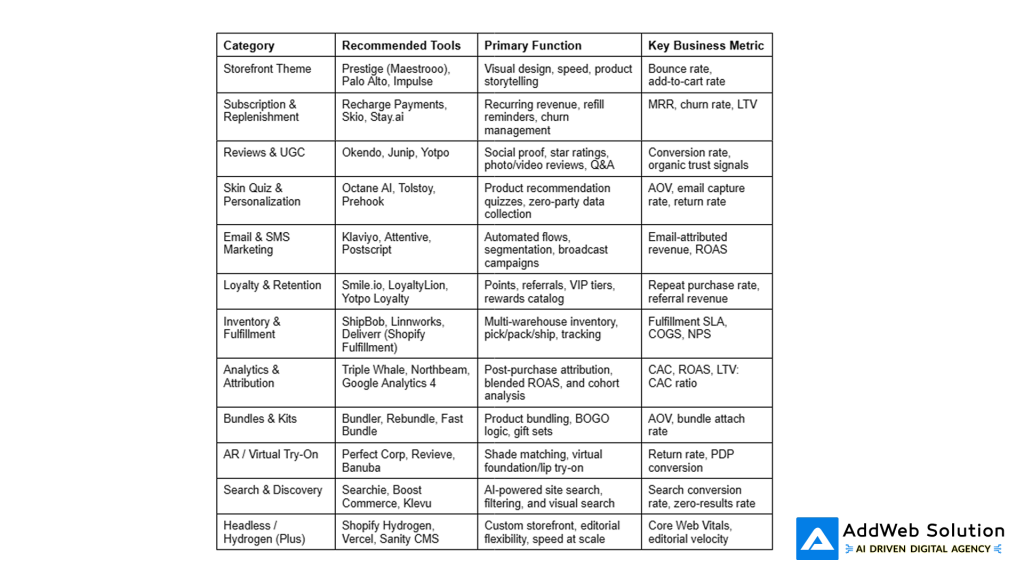
A technology stack is judged by its results, pure and simple. The table below outlines what key areas of functionality a beauty-focused Shopify store needs to excel in, what technologies help achieve that, and what metric each technology is primarily designed to move.
Core Tech Stack by Function
Tech Stack by Brand Scale
Not every beauty brand needs every tool on day one. The right stack depends on revenue stage, team capacity, and strategic priorities. Here’s a phased approach:
Tier 1: Early Stage ($0–$1M ARR)
Focus on conversion fundamentals and email. Don’t over-invest in tech before product-market fit is proven.
- Theme: Prestige or Dawn (free), optimized for mobile speed
- Email: Klaviyo (welcome flow, abandoned cart, post-purchase flow minimum)
- Reviews: Okendo or Junip, start collecting social proof from day one
- Payments: Shop Pay, Apple Pay, Google Pay via Shopify Payments, plus one BNPL option
- Analytics: GA4 + Shopify native analytics
Tier 2: Growth Stage ($1M–$10M ARR)
Layer in retention, personalization, and data infrastructure as conversion rates stabilize.
- Subscriptions: Recharge or Skio, launch a replenishment subscription for your top 2-3 SKUs
- Loyalty: Smile.io, simple points program, referral loop
- Personalization: Octane AI quiz, capture zero-party data, and route to the right products
- Attribution: Triple Whale, get visibility on blended ROAS across channels
- SMS: Attentive or Postscript, high-intent segments only (subscribers, VIPs, back-in-stock)
Tier 3: Scale Stage ($10M+ ARR) / Shopify Plus
At scale, the focus shifts to operational efficiency, international expansion, and headless performance.
- Checkout Extensibility: Shopify Functions for discount logic, Checkout UI extensions for upsells
- Hydrogen storefront: if editorial experience and speed are strategic differentiators
- Advanced loyalty: LoyaltyLion or Yotpo Loyalty with tiered VIP programs
- AR: Perfect Corp or Revieve integration, return rate reduction at scale justifies the investment
- Headless CMS: Sanity or Contentful for editorial + product content flexibility


Shopify Features That Matter Most for Beauty Brands
Shopify Markets: International Expansion Without Complexity
Beauty is by nature global. If the product line is popular in America, there’s an extremely high chance that it’ll do well in Britain, Australia, UAE, and even South Korea. With Shopify Markets, beauty brands can create a localized shop using one Shopify admin with local currencies, translated text, duty-inclusive prices, and even localized payment options.
Features for selling internationally in the beauty industry:
- Automatic currency conversion based on local price roundings
- Automated duties and taxes at checkout (no customs charges surprise at delivery)
- Localized payment gateways: iDEAL (Netherlands), Klarna (Germany & UK), Alipay (China)
- Country-specific sub-domains or top-level domain: yourstore.co.uk, yourstore.com.au
Shopify Flow: Automating Beauty-Specific Operations
Shopify Flow is a native automation tool (available on Shopify and Plus) that allows brands to build rule-based workflows without code. For beauty brands, common Flow automations include:
- Tag customers who purchase 3+ times as ‘VIP’ and trigger a loyalty program welcome
- Automatically apply the ‘replenishment reminder’ tag 60 days after the purchase of a specific serum
- Flag orders containing shade-specific SKUs for quality check before fulfillment
- Pause subscription renewals for customers with 3+ unprocessed complaints in the last 30 days
Metafields & Metaobjects: Structured Product Data for Beauty
A beauty product possesses a number of structured pieces of information that are not supported out-of-the-box by Shopify’s product fields, skin types, ingredients, concentrations, INCI names, certifications, pH values, frequency of use, etc. This can be easily solved with the help of Metafields and Metaobjects introduced by Shopify in 2022.
It brings two significant advantages: first, it allows filtering the products intelligently (‘suitable for oily skin’, ‘contains retinol’, etc.) and second, it facilitates the creation of rich structured data for better SEO performance.
Shop Pay Installments: BNPL for Higher AOV Beauty
Buy Now, Pay Later (BNPL) is particularly effective in beauty for purchases above $80-100, premium moisturizers, multi-step routine sets, professional-grade devices. Shop Pay Installments (powered by Affirm) integrates natively into Shopify checkout and allows customers to split purchases into 4 interest-free payments or longer-term installment plans.
The data on BNPL impact in beauty is consistent: surfacing a BNPL option prominently on the product page and in cart reduces checkout abandonment for high-AOV transactions and increases the frequency of customers purchasing premium SKUs over entry-level alternatives.
Benchmarks Worth Knowing: Beauty eCommerce KPIs
The table below consolidates industry benchmarks for beauty and skincare DTC brands on Shopify. Use these as planning anchors, not absolute targets, your numbers will vary by price point, acquisition channel mix, and category (color cosmetics vs. skincare vs. fragrance).

Common Mistakes Beauty Brands Make on Shopify
Fifteen years of beauty eCommerce has produced a fairly predictable set of failure patterns. None of these are fatal; they’re all fixable, but each one costs real revenue every day it persists.
Mistake 1: Treating the Product Page as a Catalogue Entry
The aspect of beauty Shopify stores that performs the worst is always the product page. Brands tend to add only a product title, product description, and one product image. Best beauty PDP pages have the following features: 6 to 10 images (lifestyle shots, texture shot, before/after shot, shade range), video, ingredients list, skin compatibility chart, more than 50 reviews including photos, how-to guide, complimentary item suggestion, and refills/subscriptions. The difference between an average PDP and a complete PDP is about 1 to 2 percentage points, and even at high traffic levels, it can mean a lot of money lost per month.
Mistake 2: No Post-Purchase Email Sequence
Most beauty brands create their abandoned cart flows but overlook post-purchase flows completely. This is a major mistake because post-purchase flows like ‘how to use your new serum’, ‘results timeline’, ‘what to use with it’ gather reviews, minimize help desk tickets, maximize attach rate on complimentary products, and create an educational connection to retain subscribers. The proper Klaviyo post-purchase flow setup should provide you with 8-15% of email income.
Mistake 3: Ignoring Site Search
Site search is utilized by 15 to 30 percent of visitors to beauty stores, and searchers tend to convert at 3 to 5 times the rate of visitors who are browsing. However, most beauty brands operate with the default Shopify site search function without optimization, synonym mapping, and product ranking rules. Tools such as Boost Commerce and Klevu, with optimized synonym mapping rules such as ‘retinol’ = ‘vitamin A’, ‘SPF’ = ‘sunscreen’, and product boosting, could help drive sales through this high-intent audience.
Mistake 4: Single-Channel Attribution Dependence
For beauty companies that rely entirely on paid last click attribution for their conversions, there is significant underspending of the company’s budget in terms of organic traffic, emails, and social media. The importance of multi-touch attribution through companies such as Triple Whale or Northbeam cannot be overstated, especially for those spending over $30K/month in paid media.
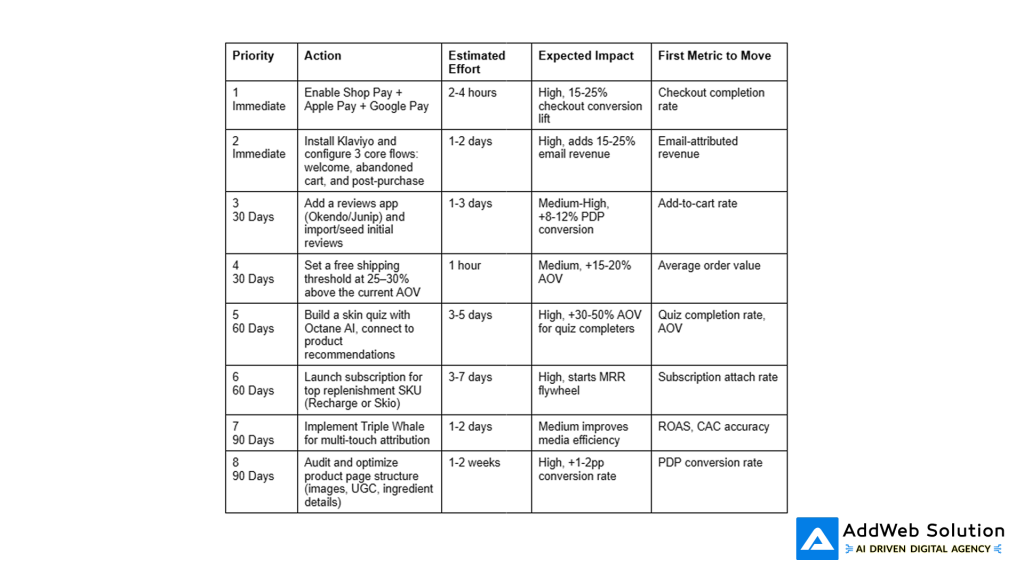
What to Prioritize First: A Practical Roadmap
If you’re overwhelmed by the breadth of tools and optimizations available, here’s a prioritized action framework based on ROI potential versus implementation effort:
Ready to build a high-converting Shopify store for your beauty brand? Talk to our Shopify experts and discover the growth opportunities hidden in your current eCommerce setup.

Pooja Upadhyay
Director Of People Operations & Client Relations
Source URLs:
https://www.statista.com/outlook/cmo/beauty-personal-care/worldwide
https://www.grandviewresearch.com/industry-analysis/beauty-personal-care-products-market
https://www.euromonitor.com/the-world-market-for-beauty-and-personal-care/report
https://www.shopify.com/enterprise/blog/beauty-ecommerce-trends
https://baymard.com/lists/cart-abandonment-rate
https://contentsquare.com/guides/cart-abandonment/stats
https://help.shopify.com/en/manual/online-sales-channels/social-commerce/tiktok/payments
https://www.klaviyo.com/blog/health-and-beauty-industry-benchmarks
